 Camberwell Beauty (Nymphalis antiopa)


Bonn,  GermanyBonn is home to 48 species of the 176 butterfly species currently occurring in GermanyGermany. This is 27 per cent.
However, this number was much higher: 35 species are extinct since the beginning of the last century in Bonn, GermanyBonn: so there were once 83 species, ocurring in Bonn, GermanyBonn.
As a result, Bonn, GermanyBonn has lost 42 per cent of its butterfly species.
It is pleasing that I was able to photograph 4 species in Bonn, GermanyBonn that are not listed in Reinhardt; Harpke; Caspari; Dolek; Kuehn; Musche; Trusch; Wiemers; Settele, 2020 - Verbreitungsatlas der Tagfalter und Widderchen DeutschlandsReinhardt; Harpke; Caspari; Dolek; Kuehn; Musche; Trusch; Wiemers; Settele, 2020 - Verbreitungsatlas der Tagfalter und Widderchen Deutschlands as occurring in Bonn, GermanyBonn:
 Lesser Purple EmperorApatura ilia (Denis & Schiffermüller, 1775)Lesser Purple Emperor
 Brown ArgusAricia agestis (Denis & Schiffermüller, 1775)Polyommatus agestis
 Brown Argus
 Marbled FritillaryBrenthis daphne (Denis & Schiffermüller, 1775)Marbled Fritillary
 Mallow SkipperCarcharodus alceae (Esper, 1780)Mallow Skipper
The following list shows the species that occur in Bonn, GermanyBonn and those that are extinct or missing.
 (occurring) indicates species occurring after the year 2000.
 (extinct) indicates species that occurred in Bonn, GermanyBonn between the year 1900 and 2000, but no longer after 2000.
  Duke of BurgundyHamearis lucina (Linnaeus, 1758)Duke of Burgundy,
  Baton BluePseudophilotes baton (Bergsträsser, 1779)Scolitantides batonBaton Blue,
  Woodland GraylingHipparchia fagi (Scopoli, 1763)Woodland Grayling and
  Scotch ArgusErebia aethiops (Esper, 1777)Scotch Argus occurred in Bonn, GermanyBonn before 1900 but no longer after the year 1900.
Brush-footed Butterflies (Nymphalidae)
Nymphalinae


Emperors (Apaturinae)

Theclinae (Satyrinae)


Heliconiinae

 High Brown FritillaryArgynnis adippe (Denis & Schiffermüller, 1775)Fabriciana adippeHigh Brown Fritillary


Melitaeniae


Pieridae
Whites (Pierinae)


 Large WhitePieris brassicae (Linnaeus, 1758)Cabbage ButterflyCabbage WhiteLarge Cabbage White
 Large White


Yellows (Coliadinae)


Gossamer-Winged Butterflies (Lycaenidae)
Blues (Polyommatinae)


 Dusky Large BluePhengaris nausithous (Bergsträsser, 1779)Maculinea nausithousGlaucopsyche nausithous
 Dusky Large Blue


Theclinae


Skippers (Hesperiidae)
Spread-winged Skippers (Pyrginae)


Skipperlings (Heteropterinae)


By the way: in my youth I saw a  Compton Tortoise ShellNymphalis vaualbum (Denis & Schiffermüller, 1775)Nymphalis l-albumPolygonia vau-albumVanessa l-albumPolygonia l-albumRoddia l-albumRoddia vaualbumRoddia v-albumRoddia j-albumCompton TortoiseshellFalse CommaCompton Tortoise Shell in Bonn-Kessenich on 11 March 1990, an eastern species that does not actually occur in the Rhineland.
As is the case almost everywhere in GermanyGermany, the habitats of plants and animals in Bonn, GermanyBonn have also been severely reduced or completely destroyed over recent decades. Land has been homogenised, converted, sealed or built on. In doing so, space has been created for the growing urban population and its infrastructure needs. All too often, however, it war also a matter of the economic interests of individuals. That is the crux of the matter: land has been assessed almost exclusively on the basis of its economic value. If a piece of land could be used to generate profit, its ecological value would often automatically take a back seat.
As a result, Bonn, GermanyBonn has lost a large proportion of the butterfly species that once occurred there. And this is despite the fact that Bonn, GermanyBonn has a comparatively large and protected area of woodland in the form of the Kottenforst, North Rhine-Westphalia, GermanyKottenforst. Forest-dwelling butterfly species are thriving in Bonn, GermanyBonn. Those adapted to other habitats are not. Many of these species have disappeared.
The city lacks open, heterogeneous spaces. It lacks unsealed, vegetated areas with features that disrupt the landscape and natural spatial connections between them.
Unfortunately, the situation is not much better in the area surrounding Bonn, GermanyBonn. Despite the rural landscape, species loss is also significant there.
The main factors behind the dramatic loss of biomass and biodiversity Hallmann; Sorg; Jongejans; Siepel; Hofland; Schwan; Stenmans; Müller; Sumser; Hörren; Goulson; de Kroon, 2017 - More than 75 percent decline over 27 years in total flying insect biomass in protected areas, which is not only being observed in GermanyGermany, are:
- Habitat loss: the land requirements of forestry, agriculture, transport, industry, residential buildings, etc. have almost completely consumed the available space. Near-natural areas now occur only sporadically, in isolated pockets and therefore without any spatial connection to one another. The small-scale extinction of individual species, which occurs repeatedly for natural reasons, can thus no longer be offset by immigration. Species are disappearing – forever.
- The introduction of environmental toxins: Our highly efficient, intensive farming system can no longer function without pesticides, which place a strain on the ecosystem. The causes include price pressure, manufacturers’ greed, but also a lack of awareness of our own responsibility as consumers.
The land requirements of forestry, agriculture, transport, industry, residential buildings, etc. have almost completely exhausted the available space.
Our highly efficient, intensive agriculture can no longer function without pesticides that harm the ecosystem.
The Bonner General Anzeiger wrote in an editorial commentary on 31 August 2022 on the subject of the destruction of natural areas:
Of course, the growing city needs green spaces and fresh air corridors. But it also needs space for economic development. Trade and industry in particular create jobs that are important for the social balance in society.
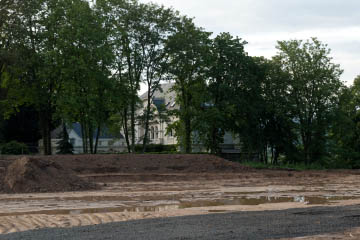
Cleared area in Bonn-Rüngsdorf near the Rhine
Photograph:
Ingo DanielsIngo Daniels; Bonn, GermanyBonn, GermanyGermany (29. June 2014, 08:56 PM)
Although the commentary does not take a clear stance: Jobs are often used as a killer argument.
These days, almost everyone recognises the value of protecting nature. However, when it comes to making personal lifestyle changes or losing status symbols, acceptance of such measures unfortunately wanes.
In my home town of Bonn, GermanyBonn, measures to protect nature and the climate are often vehemently opposed by business organisations such as the Chamber of Industry and Commerce or the Bonn/Rhein-Sieg/Euskirchen Retail Association. Even when it is simply a matter of promoting environmentally friendly modes of transport. Unfortunately, predictions of social disasters that would otherwise occur as a result of an economic crisis that is inevitable under the planned measure are met with a receptive ear by some decision-makers.
Incidentally, human-induced climate change does not necessarily lead to a decline in biomass and biodiversity:
There are habitats in which species are disappearing due to the changed conditions caused by climate change. These species can find suitable conditions again in other places. The prerequisite is, of course, that these places are also accessible to those species.
This means that a change of species can certainly take place in a habitat. It deliberately says can: Some species do not have the opportunity to relocate. This may also be due to the fact that the habitat they need simply no longer exists.
Butterfly species which are climate change winners in Bonn, GermanyBonn:
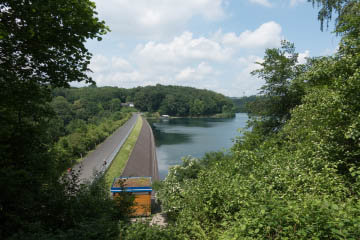
Wahnbachtalsperre dam
Photograph:
Ingo DanielsIngo Daniels; Bonn, GermanyBonn, GermanyGermany (2018)
As a child, I often went on Sunday outings with my father and brothers to the nearby Wahnbach dam (the
We always took a short walk over the dam wall through a small wooded area back to the parked car. When we stepped out of the forest, we were greeted by a beautiful, cool and damp wild meadow bordered by hedges and trees.
It was always a great pleasure to be able to observe the very special insects and butterflies there!
We travelled to the Wahnbach dam again on a spring Sunday and the anticipation was huge. We walked over the dam wall and then turned off into the forest.
When we emerged from the forest, I thought at first that we had taken the wrong path: The colourful meadow had disappeared! Many of the hedges and trees had been removed. Instead, there was just uniform short green grass. It wasn't even a private garden. It looked more like an unused area belonging to the water supplier. Insects and butterflies were now to be found in vain.
The micro-climate there was also completely different now. Presumably, the area had been drained and restored to an orderly state with German thoroughness. But why?
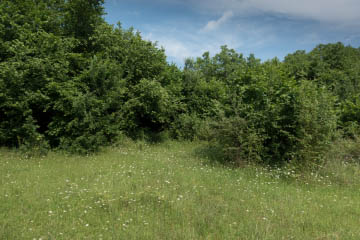
Meadow in the Greek Rhodopes near Ano Karyofyto
Photograph:
Ingo DanielsIngo Daniels; Ano Karyofyto (Άνω Καρυόφυτο),  GreeceAno Karyofyto (Άνω Καρυόφυτο), GreeceGreece (19. June 2019)
A good 30 years later, I finally made a trip to the Wahnbach dam with my children. I couldn't find the place described again. Apparently the route is now different and/or the spot is now wooded.
In the Greek Rhodopes, however, I had déjà vu in 2019:
There I found the lost wild meadow again!
The loss of butterfly species in Bonn, GermanyBonn could be halted and partially reversed.
This would not require the creation of further nature reserves and the erection of fences. Quite the opposite! Only sensitive areas or areas with high visitor pressure need special protection.
Actions in forest areas
Most butterfly species in GermanyGermany do not live in forests, but in open areas Settele, 1999 - Die Tagfalter Deutschlands. Heterogeneous areas are ideal for high species diversity and permanent populations.
To create or restore such areas, part of the Bonn, GermanyBonn forest paths should be provided with a low, overgrown fringe several metres wide in suitable places. The fringe should be kept as free of bushes and trees as possible through regular maintenance measures.
But not every emerging tree or shrub would have to be removed; it’s all about the mix: shrubs such as BlackthornPrunus spinosaSloeBlackthorn or pioneer plants establishing themselves at the forest edge could be left in place. These include, for example, Goat WillowSalix capreaPussy WillowGoat Willow and Common AspenPopulus tremulaTrembling AspenCommon Aspen, which are very valuable for insects. Until now, these woody plants have often been removed, particularly due to their low economic value.
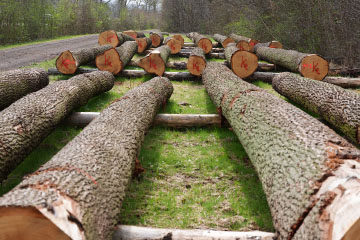
Storage area for logs in the Kottenforst next to the A565
Photograph:
Ingo DanielsIngo Daniels; Bonn, GermanyBonn, GermanyGermany (23. March 2025)
In some places in the Kottenforst, North Rhine-Westphalia, GermanyKottenforst there are already such fringes. On the path running parallel to the A565, the approx. 10 metre wide fringe is occasionally used for the storage of felled logs, which was probably also the reason for these fringes. Although this puts a strain on the fauna, these areas are characterised by a comparatively high species diversity for the Kottenforst, North Rhine-Westphalia, GermanyKottenforst.
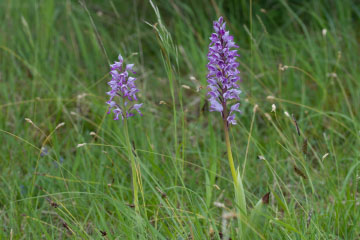
Military Orchid (Orchis militaris) in the Nature reserve Büchselberg, Eifel
Photograph:
Ingo DanielsIngo Daniels; Nature reserve Büchselberg, Eifel, North Rhine-Westphalia, GermanyNature reserve Büchselberg, Eifel, North Rhine-Westphalia, GermanyNorth Rhine-Westphalia, GermanyGermany (29. May 2022, 12:40 PM)
If suitable (e.g. soil conditions, light exposure, microclimate, neighbouring areas), a few existing forest areas should be cleared on a large scale. Once the humus layer has been removed, they would once again provide a habitat for many species that have disappeared. Examples of these species include the orchid species that used to be abundant on the Venusberg. The  Marsh FritillaryEuphydryas aurinia (Rottemburg, 1758)Eurodryas auriniaMarsh Fritillary would also be a possible candidate for resettlement, provided that biotopes are connected!
Some of the open areas created by the bark cutter in recent years should be kept permanently low.
Overall, the forest would lose a few per cent of its total area. However, species diversity and the number of individuals of plants and animals would increase disproportionately.
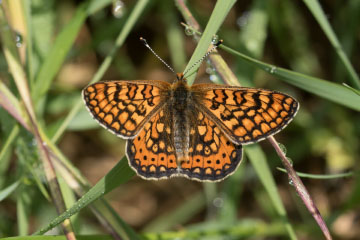
Marsh FritillaryEuphydryas aurinia (Rottemburg, 1758)Eurodryas auriniaMarsh Fritillary
Marsh Fritillary (Euphydryas aurinia) in north-east Greece
Regular, targeted tree felling should be maintained: On the one hand, they generate revenue, which can also be used for forest maintenance and the above-mentioned measures. On the other hand, they create space for the existing trees to develop better.
Less hunting and thus a higher game population should naturally increase the number of open areas.
Actions on agricultural areas
Interconnected Flower strips and the planting of hedges along borders or separations could once again create important habitats for mammals, birds and insects.
Existing agricultural land could be completely converted into ecologically valuable areas.
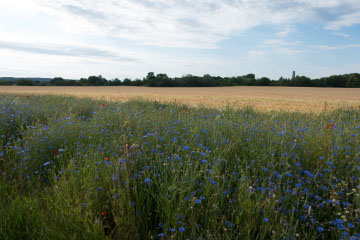
Flower strips on the Meßdorfer Feld (Bonn) (2020)
Photograph:
Ingo DanielsIngo Daniels; Bonn, GermanyBonn, GermanyGermany (13. June 2020, 06:43 PM)
June 2020: Fortunately, the above-mentioned flower strips have already been established on the Meßdorfer Feld, North Rhine-Westphalia, GermanyMeßdorfer Feld!
In Bonn, GermanyBonn, a lot has changed for the better in recent years with regard to the creation of valuable natural areas!
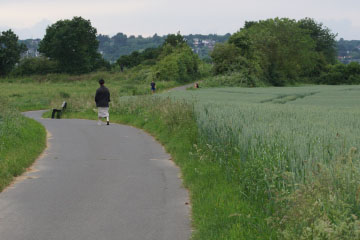
Meßdorfer Feld (Bonn) without flower strips (2026)
Photograph:
Ingo DanielsIngo Daniels; Bonn, GermanyBonn, GermanyGermany (31. May 2026, 07:42 PM)
Update May 2026: Unfortunately, the agricultural land has once again encroached almost right up to the path. The flower strip has completely disappeared, thereby destroying a network of habitats.
I am currently working to clarify the situation with the relevant department at Bonn City Council.
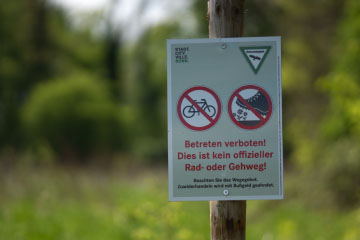
Notice board at Schleifenfelsweg between Bonn-Oberkassel and Bonn-Oberholtdorf
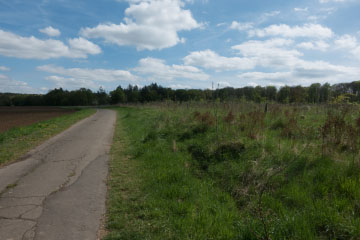
Schleifenfelsweg between Bonn-Oberkassel and Bonn-Oberholtdorf
The Landesbetrieb Wald und Holz reforested a 6.4-hectare area previously used for agriculture at the beginning of 2025.
Although this will result in an ecological enhancement of the area: It remains to be seen whether the measure will also be a noticeable benefit for the butterflies of Bonn, GermanyBonn.
In a press article from 31 March 2025, General Anzeiger Bonn: Largest reforestation in decades, the planting of trees and their function as CO2 reservoirs as well as the creation of a mowed meadow are mentioned. The proportion of meadow to forest is not mentioned. The main focus of the article is the utilisation of the action as a supplier for so-called climate or eco-points, in order to be able to implement projects in Bonn, GermanyBonn that require compensation (Handlungsfeld Kompensation of the Bonner Klimaplan).
On the positive side: by June 2026, the area indeed features a lovely mix of a wide variety of plants.
Other actions
Existing areas with ecologically less valuable vegetation (e.g. lawns) should be converted into valuable biotopes. This could not be achieved by simply not maintaining the area. Rather, depending on the respective conditions, suitable biotope types would have to be specifically identified by specialists and realised through appropriate measures. Regular maintenance measures, e.g. through mechanical activities or grazing, should preserve the biotopes in the long term.
Obstacles
In addition to financial resources and political will, the above-mentioned measures require above all broad public acceptance. Communication and information are important elements here.
The persuasion work to be done relates to many groups of people, in particular:
- Political decision-makers
- Forest owners
- Foresters
- Hunters
- Farmers
- People with a particularly strong understanding of nature, e.g. trees or a traditional nature aesthetic
- Visitors to forest and meadow
We only protect what we love.
We only love what we know.
We only keep what we would miss.